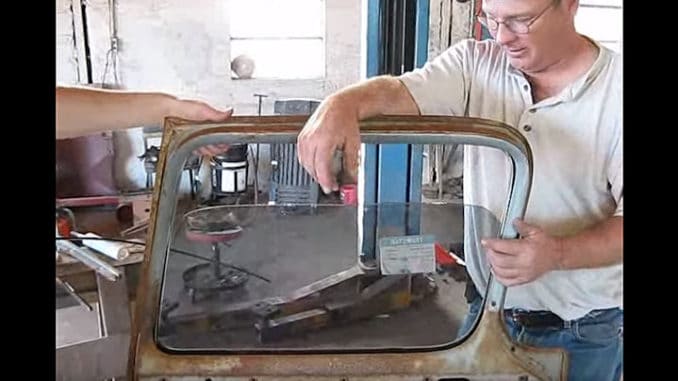
Suicide doors, arguably made best known among today's hot rodders and customizers by the Lincoln Continental four-door convertible of the 1960s, are a popular customization. Not only do they add a high level of "cool factor", they actually make entering and exiting the vehicle much easier. The occupant can enter in a natural way; walking forward towards the vehicle, and then turning as they go to sit, and exit by stepping forward out of the vehicle. It makes good sense.
Suicide doors were not uncommon on cars manufactured in the first half of the 20th century. They were especially popular in the gangster era of the 1930s because "It's a lot easier to shove somebody out with the wind holding the door open", Dave Brownell, the former editor of Hemmings Motor News stated.
Today, suicide doors can be found on a number of production vehicles, but are often referred to as "rear-hinged doors", "coach doors" (Rolls-Royce), and "freestyle doors" (Mazda). Thankfully, among car people, term "suicide doors" is alive and well.
Many hot rod and speed shops specialize in suicide doors. For many, a professional fabricator is the way to go. The first suicide doors I ever did were on a 1971 Porsche 914 and I used hinges from a Chevy Chevette - I used the left hinges on the right and vice versa, and turned the hinges upside down. It worked pretty well. But if you are handy with a cutting wheel and welder, you can tackle the job yourself with one of the many suicide door hinge kits and bear claw latch kits available today. These kits take a lot of the guess work out of the project and lend a more profession finish in the door jambs that my first try.
There is nothing cooler than a mean looking car with frenched headlights. Frenching is the act of recessing or moulding a headlight, taillight, antenna or license plate into a car body to give a smoother look to the vehicle. The name originates from the end result looking like a French cuff of a shirt sleeve, which has a ridge at the end. This modification has been used on leadsleds and customs since the 1930s.
Frenching a headlight or taillight is done in one of two ways: either removing the bezel, mounting the light deeper in the car's head or taillight recess and using the headlight rings from another car (or an aftermarket kit) to mount it deeper into the body. It can also be done by modifying the light's mountings so that they can be removed from behind, welding the bezel to the body once the chrome plating is removed and painting it body color. This gives the effect of visually lengthening the car, as well as smoothing out the body. Many customs have lights from another car transplanted in place of the original factory items, but even these are frenched as well.
L & H Race Cars recently completed building a shining example of the caliber of hotrods the produce that are known for top performance. The shop designed, built and tested this '57 Chevrolet Bel Air. As you can see from the picturs, it is a monster machine!
The L & H Race Cars facility, located in Oxford, North Carolina, is already licensed for legal I.H.R.A. and N.H.R.A. approved chassis building. The shop is fitted with all the tools and equipment to produce anything from simple customer modifications to complete turn-key solutions.http://www.landhracecars.com
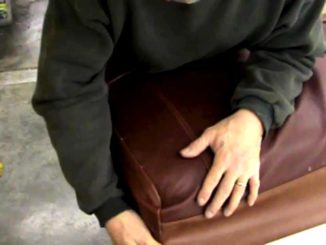
Created by Fred Bailey, this is by far the sweetest ass implement I have ever seen. This one of a kind piece of automotive beauty is hand made in metal and sprayed in sunset orange pearl automotive paint and wrapped in black leather upholstery.
The couch measures 168 inches long by 45 inches wide. Fred is entirely responsible for this honey; artist, sculptor, mechanical draftsman, welder, fabricator and licensed automotive painter - view more of Fred's artistry at http://www.fredbailey.ca/
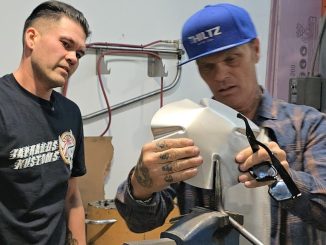
Jason Mattox of Timebomb Kustoms reminds you of an old school striper. Even with the small amount of years under his belt, Jason stays true to the old school way of striping with lots of respect for those who came before him. Jason began pinstriping about 5 years ago as a hobby and a love for the art. Balancing a full-time job and pinstriping, he managed to still do a few shows here and there. At little over 4 years ago, pinstriping became his life and his only source of income.
Based out of New Albany, Indiana; Jason started off doing local shows around southern Indiana and a few in Ohio with a hand full of work and no clientele. These days, he is usually off at shows in Pennsylvania, Kansas, Florida, and Texas with a steady list of clients. http://www.timebombkustoms.net/
Blastolene (cool in and of itself) has recently finished Piss'd Off Pete. Designed by Randy Grubb, this newest Blastolene Peterbilt hot rod features 12v71 Detriot Deisel with two 671 superchargers, and, oh yah, is currently for sale. http://www.blastolene.com
Found in the northern suburbs of Illinois, Hot Rods by Greg in Lake Bluff produces some excellent one-off custom work, including this example in a pristine Chevrolet engine compartment. The shop is responsible for both the design and fabrication of this custom engine cover.
Built by Leif Tufvesson in honor of Volvo’s 80th birthday, the Jacob is a retro-penned hotrod inspired by the first series-produced Volvo car, the ÖV4 (the Swedish abbreviation for Open Car, 4 cylinders) that gained the nickname “Jacob”. The hand-built aluminium body hotrod is based on a carbon fiber chassis and it’s equipped with Volvo’s Flexifuel, five-cylinder turbocharged engine that generates 265 Hp.
The entire build is typical of Leif Tufvesson's style. Lean. Aesthetically elegant. Stylishly minimalist. Largely because most of the components have been hidden away inside the body. For instance the springs and dampers, the electrical components and exhaust system. The result is that the body and axles look like they are floating in the air. Design Brilliance.
Desert Racing is a big-dollar sport, and the no-expense spared trucks are assembled with some of the most impressive fabrication you’re ever likely to see. They need to withstand the extreme levels of punishment associated with driving in some of the worlds harshest terrain. If you’re not into off-road racing, I’m sure you’ll at least be captivated by the builds that go along with it. Desert Racer Fabrication Build
Michael Ulman’s materials come from junk yards, dumpsters and trash heaps. Remnants of the industrial age. Objects often thought of as mundane, repurposed and reincarnated as motorcycles, race cars and speed boats. Take some time and study this guy’s work. It is very inspiring. http://michaelulman.com
In another example of vintage tools used creatively in hot rodding, this rear end is exquisite in balance and makes me wish I had a matched set of old wrenches laying around - I only seem to find them in ones.
As a racer myself and longtime NASCAR fan, I can appreciate that it's long been said that one of the things you never wanted to see in your rearview mirror was the black number 3. I would have to add this to the list: a hood and bumper mounted arsenal that appears able to handle parade-laners with ease. While this of course is a fabrication, it certainly adds an ominous feel to this flat black beauty.
I have always been a fan of creative exhaust - but generally I looked for the creativity under the car. This example, however, really grabbed my attention - I have given thought to running exhaust through the tailgate or rear quarter panel, but not the running board. Food for thought for future projects...
While there are literally hundreds of examples of crafty builders using vintage tools in their hot rod projects, I particularly liked this one. The straight pipes and curved wrench make for an excellent header support, and add character and conversation to the car.
This beautifully done flamed fan shroud was seen at the NSRA Street Rod Nationals in Louisville, KY. The shroud is done in high gauge steel and I assume plasma cut, then rolled to fit. And fit it does. The fabricator did a stellar job fitting the shroud to the grill and blind mounted it quite nicely.
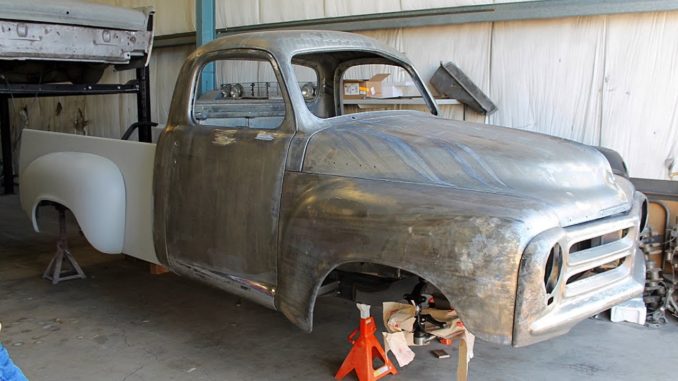
This piece of work came right out our own shop, Roadkill Rod & Custom. This is our shop truck, a 1949 Studebaker 2R5 Pick-Up.
I love the look of the Ford and Chevy firewalls when filled, nice and clean. This truck has the ugliest firewall around. As a matter of fact, because of this, I almost passed on the truck. Studebaker thought this was a feature because you had easy access to all in the dash, gauges and the like.
After two afternoons with a power wire brush, grinder and alot of cutting wheels, I have removed the glove box and all sheet metal that ran fresh air to the cab and a bunch of other useless crap. I'll redo the fresh air vents, will shrink the glove box, and will weld up all the freakin' holes left behind. The vent holes (rectangles) will also be closed up and relocated.
A spare tailgate was then cut to fit and widened to fill the hole. A dozen or so bungs were welded in and the finished cover was mounted with hex head cap screws. Skimmed and primed, the cover looks like it came that way from the factory.
The Beatersville Car Show in Louisville, KY dished up alot of creative work, and this tail light was one of my favorite examples. While the concept is pretty simple, it is a creative way to mount the lens, hide the wiring, and add some cool factor all at the same time.
This Chevrolet was seen at Dillehay Street Hullabaloo. A chrome Chevy bowtie emblem was cleanly mounted using double sided tape on the fan shroud of this very clean engine compartment.
My late Father use to tell me that "sometimes, less is more". And that is the case with this Chevy tailgate seen at the Beatersville Car Show in Louisville, KY. A plasma cutter and a steady hand was all that was required to dress this tailgate to the owners liking.
Gas Money -- I love this. Found at the Dillehay Street Hullabaloo, this International not only uses a comical bottle opener on the tailgate, but repurposes a change slot to support the driving habits of the owner. With gas prices where they are, I have to wonder if the opener is provided solely as a service to passers-by and is banking on good-will, or if this enterprising chap keeps a stocked cooler close and pimps the value-added service of the opener. No tin cans or pull-tabs for this guy.